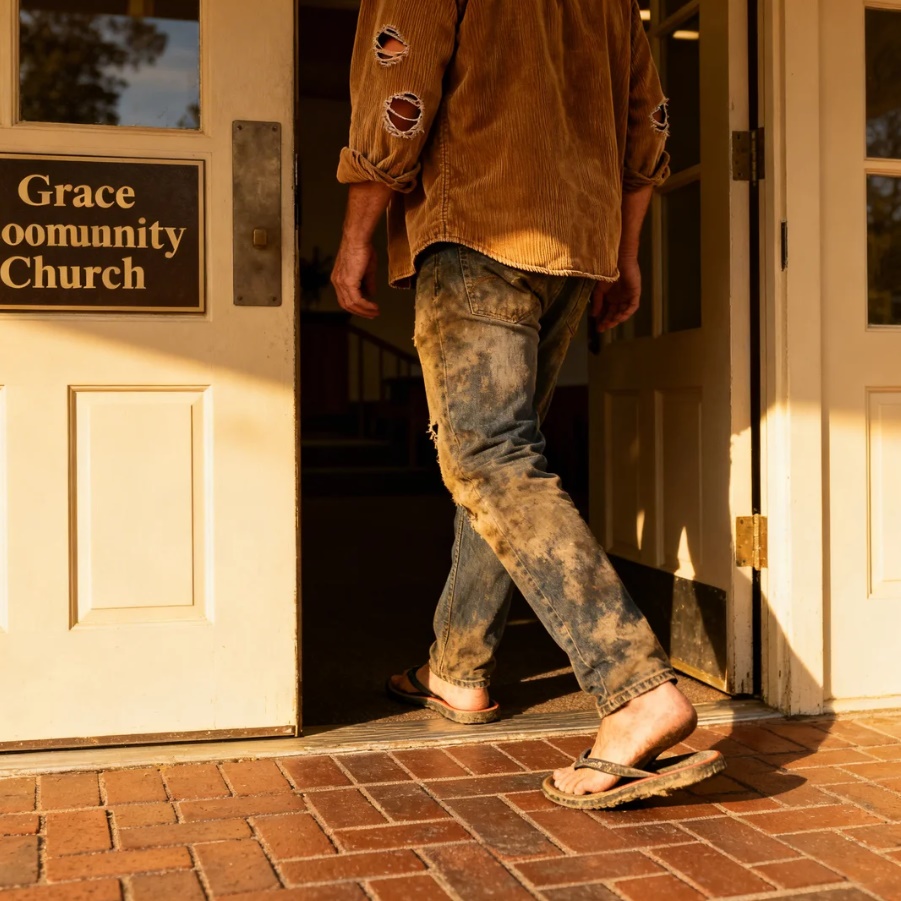
He walked through the front door of Grace Community Church on a Sunday morning, dragging worn flip-flops across
the clean tile floor, wearing dirt stained jeans and a plaid shirt with holes at both elbows. The smell of
someone who hadn’t showered in days arrived before he did. The small group of people gathered near the entrance,
laughing, buzzing with excitement about the arrival of their new pastor, immediately stepped back, wrinkling
their noses, turning their faces away. Nobody wanted to stand too close. No one knew that the shabby man in the worn
flip-flops was exactly the pastor they had been waiting for. No one imagined that in the next two hours that dirty
and smelly stranger would uncover something the church had kept hidden even from itself behind all its bright
smiles and warm handshakes. Hello friends, welcome to our story. Before we
start, please like this video and subscribe. Also tell us in the comments where are you watching from? New York,
London, maybe South Africa or Jamaica? We want to know. Pastor Samuel Harper
was 38 years old. And he carried a conviction that very few pastors had the courage to hold on to. Before you can
shepherd a flock, you must first know the true heart of the sheep. Not from reading membership reports. Not from
sitting in formal meetings with church leaders. Not from looking at attendance numbers or listening to what people say
when they know the pastor is in the room. You learn the true heart of a congregation by watching how people
actually behave when they think no one important is looking. Samuel had not always believed this. He had learned it
the hard way, the way most important lessons are learned, through failure and pain. His first church had been a small
congregation of about 50 members on the quiet outskirts of the city. A modest little building with a leaking roof and
a secondhand piano that always played slightly out of tune. He had arrived there at 28 years old, fresh out of
theology school, his head full of ideas and his chest full of fire. He had plans. He had vision. He had a 5-year
program written out in a notebook with color-coded sections. In 6 months, he had cut the church in half. He changed
the music before anyone was ready. He rearranged the service structure without asking the people who had built it. He
introduced new programs that nobody had asked for and canceled old traditions that people quietly loved. He moved
fast, talked loud, and led hard. And the people left, first in ones and twos, then in whole families. Those who stayed
were bruised and suspicious, sitting in the pews with their arms crossed, waiting to see what else he would take
from them. Samuel had stood at the front of that half- empty hall one Sunday morning and felt something cold settle
in his stomach. This was not transformation. This was destruction, and he had done it with the best
intentions in the world. He spent 3 months in a dark place after that, questioning himself, questioning his
calling, wondering if he had ever been meant to lead anyone at all. It was his wife Rachel who pulled him out of it.
Rachel was a primary school teacher, the kind of person who could explain a hard thing simply and make you feel somehow
that you had always known it. One evening, she sat across from him at the kitchen table, folded her hands, and
looked at him with those clear, steady eyes. “Samuel,” she said, “you failed because you tried to be the pastor you
thought they needed without first finding out who they actually were. You started to speak.” She shook her head
gently. A pastor is not a manager who arrives and rearranges the furniture. He’s a doctor and a doctor doesn’t walk
into the room and start writing prescriptions before he’s examined the patient. First you diagnose, then you
treat. Samuel sat with those words for a long time. He went back to the people he had hurt. He knocked on doors. He sat in
living rooms and drank tea he didn’t want and listened. Really listened without an agenda or a notebook. He
heard things he hadn’t known. He learned names he was ashamed not to already know. He discovered that the old song he
had removed from the Sunday service had been the song playing at a widow’s husband’s funeral, and that singing it
each week was the closest she still felt to the man she had lost. He brought the song back. He apologized, not from the
pulpit, but face to face, one person at a time. It took almost a year to repair what he had broken in 6 months. But he
repaired it. And when he finally left that church 4 years later, those 50 members had quietly grown to over 100.
The leaking roof had been fixed, and the old piano had been replaced by a small but decent keyboard that stayed
perfectly in tune. His second church, he did everything differently. He spent three full months doing almost nothing
but watching and listening. He visited homes. He sat at the back during services and observed. He learned not
just people’s names, but their stories, their wounds, their joys, their fears, the things they were proud of, and the
things that kept them up at night. Only then, slowly and carefully, did he begin to lead. That church grew in ways that
surprised even him. Not because of programs or events or clever strategies, but because the people felt known, and
people will follow a pastor who truly knows them almost anywhere. Now, at 38, with 10 years of ministry behind him,
Samuel was standing at the biggest door of his career. His denomination had assigned him to Grace Community Church,
a solid, wellestablished congregation of 150 members in a busy part of the city.
The church was 52 years old, built on a foundation of tradition, strong doctrine, and genuine community. For 22
years, it had been led by Pastor George Allen, a gentle and deeply loved man who had recently retired at 71 due to his
health. The congregation had said goodbye to him with tears and a standing ovation that lasted several minutes. Now
the church was like a house whose father had gone, waiting, hopeful, a little nervous, and they were ready for Samuel,
more than ready. They had repainted the pastor’s office. They had organized a formal welcome service for that Sunday
afternoon with a printed program and a special choir arrangement. Someone had made a large handpainted banner that
read, “Welcome, Pastor Samuel,” in bright blue and gold letters. The ladies committee had prepared a lunch spread
that reportedly included three different kinds of pie. They were eager. They were organized. They were, by every visible
measure, a warm and loving church. But Samuel had been in ministry long enough to know that what a church looks like on
its best Sunday. Dressed up, prepared, expecting important company is not always what a church looks like when it
doesn’t know anyone is watching. Expectations he had learned do not always reflect reality. And so 2 weeks
before his official arrival, during a long quiet evening of prayer, a question had formed in his heart and refused to
leave. These people say they are loving, but are they not loving to each other? They knew each other. Not loving to
important guests. They were prepared for those. But loving to the person who arrives with nothing. The person who
looks wrong, smells wrong, fits into none of the right categories. The question pressed on him until he made a
decision. He would arrive at Grace Community Church twice on the same Sunday. The first time as nobody, the
second time as their pastor, and the gap between how they treated nobody and how they treated their pastor would tell him
everything he needed to know about the true condition of their hearts. He had called Rachel from his hotel room to
tell her. There was a short silence on the line. Then she said, “It’s wise, Samuel. But be ready for what you might
find.” “I know,” he said. “Do you?” she asked quietly. He hadn’t answered that.
He wasn’t sure. He had found the old clothes at a thrift shop 2 days before. The jeans with the torn knee, the plaid
shirt with the worn elbows, the flip-flops with the thin flat saws. That morning, he had rubbed a small amount of
real soil under his fingernails and along his forearms. He had skipped his shower. He had left his phone, his
wallet, his wedding ring, and every other marker of who he was locked in the hotel room. He carried only two things:
an old Bible with a cracked spine, and two 50 cent coins in his pocket. $1.
Everything the beggar had. He had walked the 20 minutes to the church in the morning heat. And by the time the white
brick building came into view, neat and handsome with its tidy flower beds and half full parking lot, the sun had
warmed his shirt and the sweat had done its work. He stopped on the sidewalk and looked at the church for a moment.
Families were arriving. Clean clothes, polished shoes, children, and neat outfits. The sound of greetings carrying
across the parking lot. Above the front entrance, a banner, “Welcome. All are loved here.” Samuel read it once. Then
he tucked his old Bible under his arm, pushed the hair from his forehead, and walked toward the door. The test had
already begun. The small group near the entrance saw him coming before he even reached the steps. There were four of
them, two men and two women, standing in a loose circle just outside the front door, paper cups of coffee in their
hands, deep in a conversation that had the warm, easy feeling of people who have known each other for years. Samuel
could hear pieces of it as he approached. They were talking about the new pastor, about how excited they were,
about how the welcome service that afternoon was going to be something special. I heard he’s very anointed, one
of the women was saying. Pastor George spoke very highly of him. The denomination wouldn’t send us just
anyone, the other man agreed, nodding firmly. Not after 22 years with Pastor George. They know we deserve someone
good. Samuel walked up the steps toward the door. The smell reached them before he did. It was subtle at first and then
it wasn’t. He watched it move across their faces the way a cold breeze moves across water. The woman who had been
speaking stopped mid-sentence. The man beside her blinked. Nobody said anything rude. Nobody pointed or laughed. They
simply shifted. Bodies turning slightly away. A step back here a half turn there. One of the women raised her
coffee cup closer to her nose. The conversation died quietly the way a candle dies when you put a glass over
Samuel walked between them and pushed open the front door. Nobody said good morning. Nobody said anything at
all. Inside, the foyer was cool and bright, a welcome relief from the heat outside. Fresh flowers on the round
entrance table. Soft piano music drifting from the main hall. A welcome table with neatly stacked bulletins and
a bowl of wrapped candy. And at the door to the main hall, Sister Nancy Samuel
had not yet learned her name, but he could read her immediately. 60, maybe a little older, burgundy jacket,
clipboard. The composed, ready look of someone who has stood at this exact post more Sundays than she can count. A woman
who took her role seriously, which was, he thought, genuinely admirable. He watched her greet the couple just ahead
of him. Her whole face changed. Her arms opened slightly. Her shoulders dropped. Her voice rose with genuine pleasure.
The Millers. Oh, how wonderful, Tom. You look so well, Susan. I love that dress.
She clasped the woman’s hands. She laughed at something the husband said. She leaned in like a person who is truly
glad to see another person. Samuel stepped forward. NY’s eyes moved to him.
The warmth didn’t disappear exactly, just thinned like warm water being slowly diluted with cold. Her hands
stayed at her sides. Her smile remained, but it was a different smile now. The professional kind, the one that does its
job without meaning very much. Good morning, she said. Good morning, Samuel
said. He smiled at her. First time here, mumm. She nodded once. The way you nod
at information that doesn’t require a response. Her eyes had already begun to drift past him toward the door. Service
is starting soon. You can find a seat inside. No bulletin placed into his hands. No. So glad you found us. No. Let
me know if you need anything. Samuel picked up his own bulletin from the table. He walked through the door into
the main hall. The hall was beautiful in the morning light. High windows, warm wooden pews, a simple cross at the
front, the kind of space that had absorbed decades of prayers and hymns, and the quiet weight of people coming
before God with their whole lives. About a 100 people were already seated with more filing in steadily. The low hum of
conversation mixed with the piano into something that felt from a distance like warmth. Samuel walked slowly down the
left side aisle, looking for a seat. The first open space he saw was on the end of a middle pew, just one seat between
the aisle and a well-dressed man in a navy suit. Samuel moved toward it. The man in the navy suit saw him coming. His
reaction was so smooth, so practiced that someone not paying close attention might have missed it entirely. He simply
reached down, lifted his folded jacket from his lap, and placed it on the empty seat beside him. Then his Bible went on
top of the jacket. then his phone. A small fortress of personal belongings built in under 4 seconds. He looked back
up at the front of the hall. His face said nothing. Samuel moved on. The next
space was in a row occupied by two elderly women near the center of the hall. He turned and stepped politely
toward the pew. The woman closest to him looked up. She had a soft face, the kind
of face that probably looked kindly have been kind in most situations. I’m
sorry, sweetheart, she said, and her voice was almost gentle. These seats are saved. Samuel looked at the empty
stretch of pew on either side of her. Three, maybe four seats, all of them empty. All of them apparently spoken
for. Of course, he said quietly. Sorry to bother you, she had already looked
away. He kept walking toward the back, trying one more row. a polite gesture toward a gap near the window, met with a
young man who spread his arms wide along the back of the pew in a way that made the space beside him feel distinctly
uninviting. Samuel ended up in the very last row. The far corner where the morning light didn’t quite reach, and
the wall was close enough to feel. He sat down, set his cracked Bible on his lap, and looked toward the cross at the
front of the room. Around him, the church breathed and talked and prepared itself for worship. In his corner, there
was only stillness. He didn’t reach for his bulletin yet. He just sat for a moment, feeling the full weight of where
he was, not in self-pity, but with the deliberate attention of a man collecting information that the mind wants to
soften and the heart wants to refuse. Then the voice came from behind him near the side hallway. Low, but not low
enough. Nancy, who is that man at the back? The one who came in alone. Samuel
kept his eyes on the cross. Don’t know. Walked in off the street, I think. Poss.
Keep an eye on him, will you? I don’t want anything going missing. Big day today with the pastor coming and
everything. I’ll watch him. Good. Footsteps moved away. Samuel breathed
slowly. He opened his Bible and found the Psalms the way he always did when he needed something solid beneath his feet.
His eyes found a verse almost without looking for it. He raises the poor from the dust and lifts the needy from the
ash heap. He read it twice. Then the worship team took the stage and the service began. The singing was genuinely
good. He would not take that away from them. The song leader, a young man with a strong, clear voice and real feeling
in his face, led the congregation through four songs, and the people sang with the kind of energy that comes from
actually believing the words, hands raised, eyes closed. The hall filled up with sound that pressed warmly against
the windows. Samuel sang too quietly, alone in his corner. The usher who came
down his row with service bulletins paused at each person and then stepped past Samuel without stopping, not quite
meeting his eyes. He didn’t call after him. He had his own bulletin. He sang
the last verse of the final worship song by himself, his voice barely above a whisper, the cracked Bible open in his
lap. Then Elder Thomas took the pulpit. He was a tall man, silver-haired,
composed with the natural gravity of someone who had spent decades being listened to. When he adjusted the
microphone and looked out over the congregation, the room quieted with a speed that told Samuel everything about
the man standing here. “Turn with me,” Elder Thomas said to the Gospel of Luke,
chapter 10, verse 25. The sound of turning pages swept across the hall. The
Good Samaritan, Samuel felt something tightened gently in his chest. Of all the texts, of all the Sundays, Thomas
preached well. That had to be said honestly. He was structured, clear, and occasionally moving. He used a story
about his own grandson to bring the parable to life, and it worked. He held the room without effort. The priest saw
the man, Thomas read, his finger tracing the page, and passed by on the other side. He looked up. He saw him. Thomas
repeated more slowly. He didn’t miss him. He didn’t walk by because he failed to notice. He saw the man, and he chose
the other side of the road. The hall was very quiet. The Levite did the same. Two
men of God, two men with titles, with responsibilities, with long records of faithful service. And both of them,
Thomas paused, chose the other side. Amen, said a voice somewhere in the middle of the hall. The question is not
whether we see the person in need, Thomas continued. The question is what we do once we’ve seen them. Amen. Preach
The hall warmed with agreement, heads nodded, faces opened up. the
comfortable feeling of a congregation receiving a truth they recognize. A truth about compassion, about stopping,
about choosing the right side of the road. Samuel looked out at those faces from his back corner. These same faces
had watched him walk to the last row and said nothing. He felt no anger. He had examined that carefully and found it was
true. There was no anger in him. What was there was harder to name. Something like the feeling you get when you open a
gift and find that the box is empty. Not rage, just a quiet, aching recognition.
The sermon ended. Thomas prayed a strong, genuine prayer and said, “Amen.”
Then the offering baskets came out. Samuel reached into his pocket. His fingers found the two coins. He held
them for a moment, feeling their smallness in his palm. The basket moved along his row toward him. He watched it
pass from hand to hand, watched the bills fold in softly. When it reached him, he set the two coins inside. The
sound they made was small and thin, a sound that stood out precisely because it was different from everything around
The deacon holding the long-handled basket glanced down at the coins, then up at Samuel. The look lasted no more
than a second and a half. But in that second and a half, Samuel read everything clearly. The flicker of
something that was not quite contempt, but was its close neighbor. The slight settling of the deacon’s expression into
a polite blankness that was its own kind of judgment. The basket moved on. The service closed with a final song and a
short benediction. People rose and the hall filled immediately with the sound of reconnection. Laughter, handshakes,
the high voices of children released from sitting still. Samuel stood. He tucked his Bible under his arm and
walked slowly toward the exit. Moving through the clusters of conversation, the way a ghost moves through a crowded
room, present but not seen. He passed a group of four men talking by the second row pew. The same four men he noticed
who had the widest smiles and the loudest amens during the sermon about stopping for the person on the road.
None of them looked up as he passed. He came through the foyer. Nancy was already deep in conversation near the
welcome table. Her back naturally turned toward the door. He walked past the flower arrangement, past the candy bowl,
past the banner above the door. All are loved here. He stepped outside. The morning had grown warmer. The parking
lot was beginning to fill with small groups of people who had spilled out of the church, continuing conversations
that the end of service had interrupted. The sound of it reached him. Easy, genuine, comfortable. These were people
who genuinely loved each other. He could hear it clearly. He stood on the front path and felt the sun on his stained
shirt. And he thought, “It is not that these people have no love. They have plenty of it. They just have it arranged
very carefully. They give it to people who look like the people they already love.” And that arrangement, so
comfortable, so invisible to them, is exactly the thing that must change. He was still standing there turning this
over in his mind when a voice came from just beside him. Hey, are you leaving already? He turned. She was young,
mid20s, maybe small in height, but upright in the way she stood like a person who had decided some time ago to
stop making herself smaller than she was. She wore a simple yellow dress and flat shoes, and her hair was pulled
back. She was looking directly at him, not past him, not through him, with eyes that were bright and completely
unguarded. She was also, Samuel noticed, holding two paper cups of the coffee from inside. She held one out toward
him. “I saw you sitting alone in the back,” she said simply. “I thought you might want some. It’s not great coffee,
just so you know. But it’s hot.” Samuel looked at the cup, then at her face.
“Thank you,” he said. He took it. She smiled. the straightforward smile of someone who has done a small thing and
is not looking for praise for it. I’m Deborah, she said. I’ve only been coming here about 3 months, so I’m still pretty
new myself. Is this your first time? Yes, he said. Did you like it? He
considered that carefully. The worship was very good, he said. And the sermon.
Deborah nodded. Elder Thomas is a great preacher. A little intimidating, but great. She sipped her coffee. Then in
the same casual tone, “Are you staying for the lunch? They do it every Sunday in the fellowship hall. There’s always
too much food, which is the right amount.” Samuel paused. In all the careful planning he had done for today,
the clothes, the coins, the route to the church, the things to watch for, he had not fully imagined this. He had expected
rejection and found it. He had not expected this. A young woman in a yellow dress holding out a cup of bad coffee
like it was the most natural thing in the world. I don’t know if I’d be welcome, he said honestly. Deborah’s
brow creased slightly. Of course, you’re welcome. It’s a church lunch. You don’t need an invitation. She said it with a
light firmness. The way you stayed, a thing that should not need stating. Come on, I’ll walk in with you. The
fellowship hall was at the back of the building, connected to the main church by a short covered walkway that smelled
of old wood and floor polish. Deborah walked beside Samuel through it, talking easily, the way some people can talk to
anyone without seeming to try. She told him she worked at a clothing store downtown, women’s wear mostly. She told
him she had started coming to Grace Community Church 3 months ago after a co-orker had invited her twice and she
had run out of excuses not to come. She laughed when she said that like it was a joke on herself. I didn’t grow up in
church, she said. So everything is still kind of new to me. Sometimes I don’t know what I’m supposed to do or when I’m
supposed to stand up, she glanced at him sideways. Does that ever stop feeling awkward? Eventually, Samuel said mostly.
She laughed again. He found himself thinking that there was something genuinely restful about her company. She
was not performing anything. She was not trying to impress him or assess him or figure out what category to put him in.
She was simply walking beside him, talking to him, treating the conversation as if it were the most ordinary thing, which he supposed it
was. It was only ordinary human decency. The fact that it felt remarkable, said something about the morning he had just
had. They pushed through the door into the fellowship hall. The room was long and well lit with folding tables
arranged in rows, each one covered in a white paper tablecloth and set with plates and plastic cutlery. Along one
wall, the food had been laid out on a serving table. And it was, as Deborah had promised, a serious amount of food.
Roast chicken, rice, green beans, bread rolls, and baskets. Three pies at the
end, just as rumored. The whole room smelled of it, warm and good. About 60 or 70 people were already in the hall,
finding seats, loading plates, pulling chairs out for each other. The noise level was comfortable, not too loud, not
too quiet. The kind of sound a room makes when the people in it are genuinely at ease. Samuel took it all in
from the doorway. Deborah touched his arm lightly. Food first, then seats. That’s how it works here. She picked up
a plate and handed him one. They joined the serving line together. A few people glanced at Samuel as he moved along the
table. He noticed the glances without reacting to them. The quick involuntary assessments that most people don’t
realize they’re making. eyes that moved from his shirt to his flip-flops and back up, calculating something, he
loaded his plate quietly. “Chicken, rice, a roll. You want pie?” Deborah
asked from beside him, already moving toward the end of the table. After, he said. They turned from the serving table
and faced the room together. It was, Samuel thought, a little like standing at the edge of a swimming pool and
looking for a place to sit. Roundts everywhere. Most of them already well populated with people deep in
conversation. Groups that had formed the way groups do, organically, comfortably around existing friendships. Not
hostile, simply closed. The closing that happens not from cruelty, but from the natural gravity of people toward the
people they already know. Deborah started moving toward the nearest table. Four seats, two of them empty, two
occupied by a middle-aged couple who were looking at their plates and talking quietly. The man looked up as they
approached. His eyes went to Deborah first. A polite nod, the recognition of someone he had seen before but didn’t
know well. Then his eyes moved to Samuel. Something shifted. Not dramatically, just enough. Actually, the
man said, “We’re saving these for the Hendersons.” “Oh.” Deborah looked at the empty chairs. “Sure, no problem.” They
moved to the next table. Three women, two empty seats at the far end. One of the women caught Samuel’s eye as he and
Deborah approached, and she leaned sideways toward the woman beside her and said something low. By the time Samuel
and Deborah reached the end of the table, one of the women had set her handbag on one chair and the other had placed a folded cardigan on the second.
“Saved,” the woman said without quite looking at either of them. “Sorry,” Deborah’s jaw tightened slightly. It was
a small thing, the tiniest contraction of muscle, but Samuel noticed it. “No worries,” she said. Her voice stayed
easy. They tried a third table. A man Samuel recognized from the front pew, broad-shouldered, confident, one of the
louder Amen voices during the sermon, looked up from his conversation as they approached, glanced at Samuel’s plate
and shirt and said simply, “This table’s full.” Gesturing to the four empty chairs around him without any apparent
sense of contradiction. “Right,” Deborah said. She turned and looked at Samuel.
Her expression had changed. not angry, something more careful than anger. The
face of a person who has just seen something clearly that she had been half hoping she was imagining. “Come with
me,” she said. She led him to the far end of the hall, past the last row of tables, to a small square table pushed
against the wall near the kitchen door. It was not quite part of the main arrangement. A leftover table, the kind
that gets added when the count is higher than expected. Nobody had sat at it. It had two chairs and the same white paper
tablecloth as the others. and he noticed someone had placed a small glass of wild flowers in the center of it. The kind of
small kind thing that gets done without anyone planning it. Deborah set her plate down. Here, she said simply.
Samuel sat across from her. For a moment, neither of them said anything. The sounds of the hall went on around
them. Laughter, silverware, the particular noise of people enjoying a meal together. Then Deborah said quietly
but clearly, “I’m sorry about that. It’s all right.” Samuel said it’s not
actually. She said it without heat, just plainly. Those chairs weren’t saved. And
everyone in this room knows what a good Samaritan is supposed to do because we just sat through a whole sermon about it. Samuel looked at her carefully. She
was staring at the table, turning her fork over in her fingers. 3 months, she said. I’ve been here 3 months. I don’t
know a lot about church. She looked up at him. But I know that what just happened wasn’t right. No, he agreed. It
wasn’t. She nodded once like that settled something. Then she picked up her fork and cut into her chicken. Well,
she said, “The food’s good, at least.” Samuel looked down at his plate. He picked up his fork. “It really is,” he
said. They ate together at the small table by the kitchen door while the rest of the hall talked and laughed around
them. Deborah asked him ordinary questions, where he was from, how he had found the church, what he did for work.
He answered carefully, saying enough to be truthful without saying more than the moment required. He was passing through
the city. Someone had recommended the church. He was between things at the moment. She listened without crying,
which he appreciated. At one point, a woman came out of the kitchen carrying a fresh tray of rolls and stopped when she
saw the two of them at the corner table. She looked at Samuel for a moment, then at Deborah, and then something moved
across her face. Not hostility exactly, but the particular discomfort of someone who is not sure whether a situation
requires their attention. She set the rolls on the serving table and went back into the kitchen without saying
anything. Samuel was halfway through his rice when he heard the voice. It came from the table nearest to them. Three
men, jackets off, comfortable in the way of people who consider this room theirs. He recognized one of them as the man who
had called himself Williams during a brief exchange near the back of the sanctuary earlier that morning. the same
voice that had told Nancy to keep an eye on him. Williams was not looking at Samuel, but he was talking in the
particular way of a person who knows they can be heard and doesn’t mind. These things need to be managed
carefully, he was saying to the man beside him. Big day today with the new pastor coming. Last thing we need is
distractions. The man beside him said something low. Williams shook his head.
I’m not saying anything about anybody. I’m just saying today of all days we represent this church to a man who’s
come a long way to lead us. We want everything to look right. Samuel set his fork down very quietly. We want
everything to look right. He let those words sit in his mind for a moment, turning them over, examining them. Not
be right. Look right. Deborah had heard it too. He could tell by the way her shoulders had gone still. She was
looking at her plate her jaw set. Hey, she said quietly enough for only him to hear. She looked up. Are you okay?
Samuel met her eyes. There was something in her face. A direct unguarded concern that had nothing calculated in it. She
was not asking because it was the polite thing to ask. She was asking because she actually wanted to know. He thought
about what he was carrying. The suit in his hotel room, the afternoon service in just a few hours, the revelation that
was coming that this young woman could not yet imagine. He thought about what she had done today. the coffee, the
walking in together, the plate, the three rejected tables, the corner table by the kitchen door, the small glass of
wild flowers she hadn’t put there but had chosen anyway. “I’m okay,” he said. And then, because it was true, “Thank
you, Deborah, for today. You have no idea what this meant.” She looked at him for a second with a slight puzzlement,
as if the weight of what he’d said didn’t quite match the size of what she’d done. “I just sat with you,” she
said. “Yes,” he said. “You did.” Samuel left the fellowship hall a little after
1:00. He walked back through the covered walkway alone, through the foyer with its flowers and candy bowl, and out
through the front door into the early afternoon heat. The parking lot was still half full, people lingering as
church people do, reluctant to let Sunday go entirely. Nobody watched him leave. He walked the 20 minutes back to
the hotel at an unhurried pace, his worn flip-flops slapping quietly against the pavement, his cracked Bible under his
arm, his mind turning slowly over everything he had seen and heard that morning. The way you turn over soil to
see what’s underneath. He was not surprised. That was the honest thing to say. He was not surprised because Rachel
had warned him. And because in 10 years of ministry, he had seen enough of human nature, including his own, to know that
the gap between what people believe about themselves and how they actually behave is often wider than anyone wants
to admit. But knowing a thing and experiencing it are two different weights. He had sat in the last row
while a congregation shouted, “Amen” to a sermon about stopping for the man on the road. He had listened to a man worry
about how things would look on the day their new pastor arrived. He had been turned away from four tables in a room
full of people who prided themselves on being the loving kind. And one young woman, 3 months old in her faith, still
unsure when to stand during the service, had done more in one afternoon than all of them combined. He turned that over
carefully, too, not to make the others villains. He had been a villain himself once in a half empty church in the city,
rearranging chairs while a widow lost the only thing that still connected her to her husband. He knew what it was to
be blind to your own blindness. These were not bad people. That was the important thing to hold on to. They were
good people who had arranged their goodness in a way that worked for them, that served the familiar, the respectable, the comfortable. And that
arrangement had gone unexamined for so long that it had become invisible to them. Like a smell in a room you’ve
lived in too long. They needed a mirror, not a hammer. Today was not a trap, he
thought. It was mercy. He would remember that when he stood before them this afternoon. Back in the hotel room,
Samuel stood in the shower for a long time. He let the hot water run until the mirror fogged over completely and the
small bathroom was warm as a greenhouse. He washed the soil from under his fingernails carefully, the way you wash
something you want completely clean. He washed his hair. He stood with his face under the water and let himself be still
for a few minutes, which was something Rachel had taught him to do before any service that mattered. Don’t walk in
carrying the weight of the preparation. She had told him once, “Walking clean. Let God carry what he needs to carry.”
He dried off and stood in front of the now clear mirror. The man looking back at him looked like himself again. He
opened the garment bag hanging on the back of the door. Inside was the suit he had pressed 2 days ago and hung
carefully to keep the crease gray, simple, well-cut, not flashy. He didn’t
own flashy things. Rachel said it was one of his better qualities. He dressed slowly and deliberately. The white shirt
first, buttons done from the bottom up, the way his father had taught him, then the trousers, the jacket. He clipped his
watch onto his wrist, the simple silver one Rachel had given him on their 10th anniversary. He looked at his shoes,
polished and waiting on the floor beside the bed, and thought briefly of the flat flip-flops lying in the corner. He put
on the polished shoes. He picked up his good Bible, not the cracked one, which he placed gently on the bed, and stood
at the mirror for a moment, adjusting his collar. He thought about Deborah in her yellow dress at the corner table. I
just sat with you. He thought about Williams not looking at him, speaking carefully about how things needed to
look right. He thought about the coins dropping into the offering basket and the deacon’s 1 and 1/2 second glance. He
thought about NY’s thinning smile. He thought about the empty seats filled with jackets and Bibles and handbags. He
breathed in slowly, then out. Lord, he prayed, standing at the mirror in his gray suit. Let me be a shepherd and not
a judge. Let what I say today open something, not close it, and give me the right words because I am not always sure
I have them.” He picked up his hotel key, walked to the door, and went back out into the Sunday afternoon. The
church looked different when he returned. The parking lot was full now. Cars parked all the way to the edge of
the property. Someone had placed small potted flowers along both sides of the front path, fresher ones than the
morning, bright yellow and white, just brought out for the occasion. The handpainted banner he had been told
about was now hanging properly above the entrance, its blue and gold letters catching the afternoon light. Welcome,
Pastor Samuel. A small reception committee was gathered at the foot of the steps. Five or six people in their
best clothes, standing in a careful arrangement that suggested someone had thought about where everyone should
stand. Elder Thomas was at the front, silver-haired and composed, wearing a dark suit with a white pocket square.
Beside him, a man Samuel hadn’t yet spoken to, organized, looking watchful, who he would later learn was Williams.
Then the articulate Andrew, whom the denomination had mentioned in their briefing notes, and Nancy, now wearing a
different jacket, her clipboard nowhere to be seen, her hands clasped in front of her. They saw him coming while he was
still at the bottom of the path. Elder Thomas’s face opened into a wide, genuine smile, and he stepped forward
with his hand already extended. Pastor Samuel, welcome. Welcome. We are so glad
you’re finally here. The handshake was warm and two-handed, the kind that holds a moment longer than a regular handshake
to say, “This means something.” Elder Thomas Samuel said, “It’s a pleasure.”
Then the others came forward one by one. Williams, firm handshake, welcoming smile, eyes that assessed and approved
simultaneously. Andrew articulate immediately saying something gracious and well-fraed about the honor of the
occasion. Nancy. And here Samuel paused for just a fraction of a second because Nancy was looking at him with a warmth
that was completely different from the thin smile of the morning. And she had no idea that the man standing before her
in the gray suit and polished shoes had stood before her 6 hours ago in a stained plaid shirt and received
something else entirely. “Pastor Samuel,” she said, clasping his hand. “This church has been praying for you
for months. Welcome home. Thank you, Sister Nancy,” he said, and said it kindly because he meant it, and because
he had already decided that what happened this afternoon would not be an attack on any individual, not even the
ones who deserved it most. They walked him through the foyer, the same foyer, and into the main hall. It had been
transformed slightly from the morning service. The front area rearranged, a chair of honor placed to one side of the
pulpit, fresh flowers on the communion table. The hall was nearly full, people turning in their seats as he entered, a
wave of warm applause rising naturally and spreading back through the rows. Samuel walked down the center aisle
behind Elder Thomas, nodding left and right at faces he didn’t yet know. He passed the row where the man in the navy
suit had placed his jacket and Bible on the empty seat. The man was there now, standing with everyone else, clapping
with genuine enthusiasm. He passed the pew where the elderly woman had told him the seats were saved. She was on her
feet, her eyes bright, clapping with both hands raised slightly, the way someone claps when they are genuinely
happy. He walked to the front of the hall and turned to face them. The applause went on for a long moment. He
let it not for his own sake, but because he could see that it was real, that these people were genuinely glad that
they had waited and hoped and prepared, and that this welcome was an honest expression of something that mattered to
them. He raised one hand gently, and the hall quieted. He looked out at them, all
150 of them, filling the pews from the third row to the very back. His congregation, his flock, the people he
had come to shepherd. His eyes found Deborah near the middle of the hall, still in her yellow dress. She was
watching him with a slightly confused expression. The way a person looks when something feels familiar, but they can’t
yet work out why. He smiled at her. Then he looked at the rest of the hall. “Good afternoon,” he said. His voice was calm
and unhurried. It is genuinely good to be here. He opened his Bible. Before I
say anything else, I want to read a few verses. Matthew 25, beginning at verse
The hall was very quiet as Samuel found his place in the text, not the
quiet of a room waiting politely. The deeper quiet of a room that has somehow sensed without being told that what is
coming matters. People settled into their seats. A child who had been murmuring something to her mother
stopped. Even the air in the room seemed to slow down. Samuel read, “Then the king will say to those on his right,
come you who are blessed by my father, inherit the kingdom prepared for you from the foundation of the world. For I
was hungry and you gave me food. I was thirsty and you gave me drink. I was a stranger and you welcomed me. I was
naked and you clothed me. I was sick and you visited me. I was in prison and you came to me.” He paused. Then the
righteous will answer him, saying,”Lord, when did we see you hungry and feed you? Or thirsty and give you drink? And when
did we see you a stranger and welcome you or naked and clothe you? And when did we see you sick or in prison and
visit you?” Another pause, longer this time. And the king will answer them, “Truly I say to you, as you did it to
one of the least of these, my brothers, you did it to me.” He closed the Bible slowly. The hall waited. Samuel set the
Bible down on the pulpit and looked out at the congregation for a long moment without speaking. His hands were resting
loosely on either side of the pulpit. His face was calm, not stern, not cold, but serious in the way that a doctor’s
face is serious when he is about to tell you something true. I want to tell you about this morning, he said. Something
in the quality of those words, something in the quietness of how he said them, made several people sit up slightly
straighter without knowing why. I arrived at this church at approximately 9:45 this morning. A small shift in the
room, almost imperceptible. I was not wearing this suit. The shift became something larger. A few heads tilted. A
few brows came together. Samuel reached into his jacket pocket and placed two coins on the pulpit. They caught the
light briefly, small silver, almost nothing. I was wearing torn jeans, he
said, and a plaid shirt with holes in the elbows. I had dirt under my fingernails. I had not showered and I
had $1 in my pocket. These two 50 cent pieces which I placed in the offering this morning. The silence in the hall
changed texture completely. It became the silence of people who are suddenly rapidly rearranging something in their
minds. The silence of a picture that has just shifted and cannot shift back. He watched it move across their faces like
weather crossing a field. The man in the navy suit, his expression went very still. The elderly woman who had told
him the seats were saved brought one hand slowly up to her mouth. Nancy, seated near the side aisle, had gone a
particular shade of pale. Williams, in the third row, was staring at the pulpit with an expression that Samuel could
only describe as a man watching the floor come up to meet him. I sat in the last row, Samuel continued, his voice
unchanged, still quiet, still unhurried, because it was the only place I could find a seat. He did not say it with
accusation. He said it the way you state a fact about the weather. I heard the worship. I heard the sermon. He picked
up the coins and held them up briefly. I put these in the offering basket. And when the service ended, I walked out of
this building. And not one person said good morning to me or goodbye or come back. A sound moved through the hall.
Not a gasp exactly, more like a collective breath that had forgotten for a moment how to complete itself. A woman
in the fifth row had begun to cry quietly. Not dramatically, just the silent kind where the tears come before
the person has decided to let them. Samuel set the coins back on the pulpit. I also had lunch here today, he said in
the fellowship hall. My plate was full. The food was wonderful. Thank you for that. He said it genuinely and one or
two people caught off guard by the gentleness of it made a small broken sound between a laugh and something
else. But finding a table was more difficult. Four different tables if I’m counting right. The man who had said
this table’s full while surrounded by empty chairs was looking at his hands. I want to be clear about something, Samuel
said, and his voice was firm now, not loud, but with a weight behind it that filled the hall the way a deep bell
fills a room. I’m not telling you this to humiliate anyone. I am not standing here to punish this church or to make
anyone feel small. That is not why I came. You let that settle. I came because I believe that a shepherd who
does not know the true condition of his flock cannot help them. And because I have made the mistake before in my own
life, in my own ministry, of assuming I knew a people before I had truly seen them, he paused. So I needed to see you.
Not the version of you that was prepared for my arrival. Not the version that was dressed for the occasion and standing at
the bottom of the steps with a welcome banner. He said it without cruelty. I needed to see the version that walks in
on an ordinary Sunday morning and makes a hundred small decisions about who belongs and who doesn’t, who matters and
who can be managed. The hall was utterly still. And what I found, Samuel said, is
what I was afraid I might find. He looked out at them, all of them, every face. I found a church that loves God. I
genuinely believe that. I heard it in your worship this morning, and I felt it in your prayer. I found a church with
real knowledge of the scriptures and real devotion to its traditions. He nodded slowly. And I found a church
whose love has edges. Those three words fell into the room and stayed there. edges that it may not even know are
there. Borders that have been drawn so quietly over so many years that they have become invisible, like walls that
have always been there and so no one thinks to question them. Walls that say, “We welcome the respectable. We welcome
the familiar. We welcome the person who fits.” His voice was still steady, still
without anger. And the person who doesn’t fit, he can sit in the back row alone. And when the service ends, he can
walk out the same door he came in and the world outside will treat him exactly the way we just did. Nobody moved. The
text I just read, Samuel said, does not say, “As you did it to the respectable ones, you did it to me.” It does not
say, “As you did it to the people who smelled right and dressed right and could fill a seat without making anyone
uncomfortable, you touched the Bible.” It says, “The least of these.” The woman
in the fifth row was not the only one crying. Now Samuel looked toward the middle of the hall at the yellow dress.
There was one person, he said, who treated me differently today. Every head turned. Deborah had gone very still. Her
eyes were wide fixed on him. And Samuel could see the exact moment the pieces came together in her mind. The coffee,
the corner table, the man in the torn jeans who had said, “You have no idea what this meant.” And the color rose in
her face all at once. She is 3 months old in her faith. Samuel said she is
still learning when to stand up during the service. She is not on any leadership committee. She does not have
a title or a tenure. He looked at her directly, but she brought me coffee when no one else would meet my eyes. She
walked into the fellowship hall with me when I would have stood at the door alone. She sat with me at a table in the
corner when four other tables turned us away. He paused and she told me quietly,
clearly, and without making a speech about it that what was happening was not right. The hall was so quiet that Samuel
could hear the faint sound of the air conditioning. She quoted no verse. She made no announcement. She simply did
what the text says. He opened the Bible again briefly. She saw a stranger and she welcomed him. He closed it. In 20
years of ministry, Samuel said, and his voice was quieter now, I have met very few people whose faith is as
uncomplicated as that, whose goodness does not wait to check whether the person in front of them is worth the
effort. He looked at Deborah one more moment, then back at the congregation. She is what this church must become. The
words settled over the hall like something falling gently from a great height. She is what this church must
become. For a long moment, nobody moved. Nobody spoke. The hall held its breath
the way a room holds its breath after a thunder crack. Not from fear exactly, but from the sudden awareness of how
much power has just passed through it. Samuel stepped back slightly from the pulpit, not retreating, settling. The
way a person settles after they have set down something heavy they have been carrying all day. I want to be your
pastor, he said, and his voice was simpler now. The formal weight of the sermon giving way to something more
direct, not the pastor of the version of this church that stands at the bottom of the steps in its best clothes. The
pastor of the real one, the one that struggles and falls short and sometimes fills the empty seats with its
belongings so a stranger cannot sit down. A few broken sounds from the pews. Half laugh, half grief. That church, the
real one, is the one worth shephering because that is the one that can actually grow. He looked across the hall
slowly. The way you look at something you are choosing to take responsibility for. I am not here to embarrass you. I
am here because I believe God is not finished with Grace Community Church. I believe there is more in this room, more
love, more courage, more genuine faith than what showed itself today. and I believe that the gap between who you are
and who you are called to be is not a reason for shame. He paused. It is the whole reason I am here. He stepped away
from the pulpit entirely, came down the two steps to the floor of the hall and stood among them, not above them, not
behind any furniture. So I want to ask something of you, he said, not as a punishment, as a beginning. The hall
waited. If there is anything in you that recognized itself in what I described today, if you heard something this
afternoon that found you out, I want to invite you to bring it forward. Not to me, not to each other.” He gestured
gently toward the front of the hall, to God, who already knows and who is, I promise you, far more interested in your
honesty than your performance. Williams moved first. That surprised people afterward when they talked about it. Of
all the people they might have expected, Williams, with his pragmatic caution and his careful watchfulness, with his we
want everything to look right, Williams was the first one on his feet. He didn’t say anything. He simply stood, pushed
past the two people between him and the aisle, walked to the front of the hall, and knelt down on the carpet in front of
the first row. His shoulders were shaking before he reached the floor. For a moment, the hall just watched him.
Then Elder Thomas, silver-haired, composed, the man whose voice filled rooms without effort, made a sound that
was nothing like his preaching voice. It was small and rough and very human. He pressed his hand over his eyes. Then he
stood and walked forward and knelt beside Williams. Then Andrew, then Nancy, who moved quickly as if she had
been waiting for permission. And now that it had come, she didn’t want to waste another second. Then the man in the navy suit who walked forward with
his jacket still perfectly pressed and knelt down and put his face in his hands. Then the woman who had told
Samuel the seats were saved. She came slowly, her white hair catching the light, one hand steadying herself on the
edge of the pew as she rose. When she reached the front, she didn’t kneel, her knees wouldn’t allow it, but she stood
with her head bowed and her hands folded and her lips moving in something private. Then others, then more. They
came the way water finds its way, not all at once, in a rush, but steadily, each one following the one before,
filling the front of the hall until there was a whole congregation of people on their knees or standing with their heads bowed, and the sound of it was not
loud, but was somehow the loudest thing Samuel had heard all day. He stood among them and said nothing. There was nothing
to say. This was not the moment for more words. This was the moment to step back and let what needed to happen happen. He
had seen altars before, had stood at many of them, had called people forward at many of them, but he had never stood
at one that felt quite like this. There was no performance in it. Nobody was watching anybody else. The people around
him were not kneeling because kneeling was the right thing to do in this situation. They were kneeling because something in them had genuinely broken
open. And the only response to that kind of opening is to get low. He thought of Rachel. He wished she were here. You
were right, he thought. Be ready for what you might find. He had found something worse than he hoped and better
than he feared. He had found a church that, when confronted with its own reflection, did not argue with the
mirror. That was not nothing. That was, in fact, everything. After a long while,
the hall began to settle. People returned slowly to their seats. Eyes were wiped. Hands were squeezed. The
particular tenderness that follows a hard thing passed quietly between people who had been strangers to each other’s
real selves an hour ago. Samuel returned to the front. Thank you, he said simply.
He looked at Williams back in his seat now, his eyes red, his composure largely restored, but with something different
in it, something that had not been there before. Something that looked, Samuel thought, like relief. I want to say one
more thing before we close, Samuel said. The hall gave him its attention. What
happened here today is not the end of something. It is the beginning. He let that be clear. next Sunday and the
Sunday after that and every Sunday after that it will be possible to go back to the old arrangements to the saved seats
and the thin smiles and the careful management of who belongs and who doesn’t. That is always possible. He
nodded slowly. Old habits are strong, especially the ones we don’t know we have. He picked up the two coins from
the pulpit one more time, held them for a moment, then set them back down. But I believe this church is stronger. and I
believe I genuinely believe that the people in this room are capable of becoming what the text calls them to be.
He looked at Deborah one last time. She was sitting with her hands in her lap and her face still faintly flushed and
she looked like someone who had not yet fully decided how to feel about having the entire hall turned toward her twice
in one afternoon. But her eyes when they met his were steady. The newest among you, Samuel said, showed the rest of us
what it looks like. That is a remarkable thing. Hold on to it. He closed his Bible. Let’s pray. The prayer was short.
He had learned over the years that the best prayers after a hard thing are short. Long prayers after a hard thing
sometimes undo the hard thing. So he prayed briefly and with gratitude, not for what the church had done, but for
what it was still capable of doing. He thanked God for honesty. He asked for courage. He said, “Amen.” The
congregation said, “Amen.” And then because life is larger than its most significant moments and continues on
regardless, someone near the back said something quietly and someone else laughed. A real laugh, the surprised
kind, and the hall began to breathe again. People lingered a long time afterward, not with the easy chattiness
of after an ordinary service, with the slower, more careful quality of people who have been somewhere together and are
not quite ready to separate. Conversations happened in low voices. Some people sat with others they didn’t
normally sit with. The man in the navy suit found the deacon who had collected the offering and the two of them stood
together near the window for a long time talking in a way that looked serious and good. Nancy found Samuel near the side
door. She stood in front of him for a moment without speaking. Up close, he could see that her mascara had done what
mascara does. She looked smaller than she had at the door that morning, not diminished exactly, but more real. I’ve
been greeting people at that door for 15 years, she said. I know, he said gently.
I thought I was good at it. You are good at it, he said. For the people you are expecting. He met her eyes. The work now
is to become good at it for everyone else too. She nodded. Her chin was unsteady. I’m sorry, pastor. I know you
are, he said. And I believe you. She pressed her lips together, nodded once more, and walked away. Williams came
next, not to apologize with words, which Samuel got the sense was not entirely in Williams’ nature, but to shake his hand
with both hands and hold it for a moment and look at him directly. “You’re not what I expected,” William said. “No,”
Samuel agreed. “I think that might be exactly what we need.” “I think so, too,” Samuel said. Deborah was the last
one. Most of the congregation had gone by the time she made her way to the front of the now quiet hall. She walked
with her hands clasped in front of her and her yellow dress still bright in the dimming afternoon light coming through
the high windows. She stopped a few feet away from him and looked at him for a moment with an expression that was equal
parts amusement and something more serious. You could have just told me, she said. I could have, he agreed at the
table. When I asked if you were okay, yes, she thought about that. Why didn’t
you? Samuel considered the question honestly. because you weren’t being kind to the pastor, he said. You didn’t know
there was a pastor. You were just being kind to a person. He looked at her. I didn’t want to change what that was.
Deborah was quiet for a moment. That’s actually a good answer, she said. Thank you. She looked around the hall, the
empty pews, the fresh flowers on the communion table, the two coins still sitting on the pulpit. Then back at him.
So what happens now? She asked. To the church. I mean the same thing that happens to anything after a hard truth.
Samuel said, “We decide what to do with it. Some days we’ll do well. Some days
we’ll forget and go back to the old ways. And when that happens, we’ll need to be reminded.” He paused. That’s what
pastors are for. She nodded slowly. “And what are 3-month converts for?” He
smiled. The first full smile of a very long day. Apparently, he said, “To show
the rest of us what we’re supposed to look like.” Deborah made a face that suggested she was not entirely sure she
was comfortable with that responsibility. But underneath it, he could see that she was. Underneath it,
she was exactly the person who could carry it. “Same time next Sunday,” she said. “Same time next Sunday,” he said.
She nodded, picked up her bag from the front pew, and walked up the center aisle toward the door. At the exit, she
paused, turned back briefly. “Better coffee next week,” she said. “I’ll bring some from the shop.” Then she pushed
through the door and was gone. Samuel stood alone in the empty hall for a little while. The afternoon light was
long and amber through the high windows now falling across the wooden pews and warm strips. The flowers on the
communion table had opened slightly more than they had that morning. The way flowers do when the day warms around
them. The handpainted welcome banner he knew was still hanging above the front door outside. Welcome, Pastor Samuel. He
thought about what this church would become. He did not know exactly. Nobody ever does. But he had been in ministry
long enough to know that the churches that could be broken open were the ones that could also be rebuilt. The ones
that could not be broken open were already gone, even when their parking lots were full. These people had knelt.
That was where everything good began. He picked up the two coins from the pulpit and held them in his palm one last time.
$1, the everything of a man who had nothing. He closed his fingers around them. Then he picked up his Bible,
walked up the center aisle through the long amber light, and pushed through the door into the evening. Outside, the city
was still going about its Sunday business. Cars passing, children somewhere nearby, the smell of someone’s
dinner beginning to drift through a window, ordinary and continuing and full of people, every one of them carrying
something. Samuel stood on the front steps of Grace Community Church for a moment. Then he put the coins in his
pocket, walked down the steps, and went to call his wife. I hope you enjoyed watching it as much as I enjoyed
creating it. Like, share, and comment on the lessons you’ve learned. Let me know where you’re watching from in the
comments below. See you in my next
News

👉”Heredó una Tierra que Nadie Quería… y Descubrió un Secreto Enterrado Durante 30 Años”
👉”Heredó una Tierra que Nadie Quería… y Descubrió un Secreto Enterrado Durante 30 Años” Dicen que la tierra es lo único por lo que vale la pena luchar, porque ya no se fabrica más. Pero cuando Andrew Davies heredó cuarenta…

👉”Una Mujer Embarazada Sin Hogar Salvó a un Millonario… Lo Que Pasó Después Conmovió a Millones”
👉”Una Mujer Embarazada Sin Hogar Salvó a un Millonario… Lo Que Pasó Después Conmovió a Millones” El viento soplaba con fuerza aquella tarde gris, empujando el frío a través del puente como si quisiera vaciar la ciudad de todo calor…

👉”Heredó un Cañón Sin Valor… y Descubrió un Río que Cambió Todo”
👉”Heredó un Cañón Sin Valor… y Descubrió un Río que Cambió Todo” El cañón no tenía nombre. Y eso, con el tiempo, comprendí que decía más sobre el mundo que cualquier mapa. En una tierra donde cada arroyo, cada colina…

👉”Heredó Solo una Llave… Pero Lo Que Encontró Bajo Tierra Cambió Su Vida Para Siempre”
👉”Heredó Solo una Llave… Pero Lo Que Encontró Bajo Tierra Cambió Su Vida Para Siempre” Tenía dieciocho años cuando heredó una llave… y un agujero en la tierra. No hubo lágrimas, ni familia reunida, ni recuerdos compartidos alrededor de una…

👉”El Millonario Que Lo Tenía Todo… Descubrió Que Sus Padres Vivían de Sus Sobras”
👉”El Millonario Que Lo Tenía Todo… Descubrió Que Sus Padres Vivían de Sus Sobras” Franklin Foster era un hombre que conocía con precisión el precio de cada centímetro de mármol en el vestíbulo de su ático, pero había olvidado, hacía…

👉”Volvió Después de Años… Y La Decisión de la Hija Se Hizo Viral”
👉”Volvió Después de Años… Y La Decisión de la Hija Se Hizo Viral” El sol comenzaba a descender lentamente detrás de los picos irregulares de las montañas Blue Ridge cuando Mary llegó finalmente al borde de la vieja granja familiar….
End of content
No more pages to load