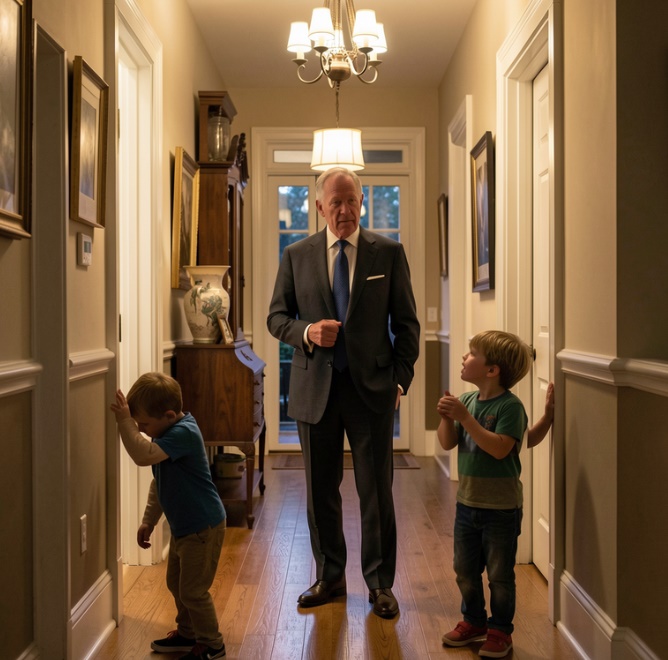
Collins was a billionaire, the kind of man who could buy a second house without thinking. Yet every night he stood in
his hallway like a helpless stranger in his own home, listening to his twin boys
refuse sleep. He had paid four nannies more money than most people make in a
year just to help his twin sons, Victor and Murphy, sleep, and all four of them
failed. Victor and Murphy did not cry like normal kids. They did not ask for
water. They did not beg for one more story. They did something worse. They
stayed awake, laughing, running, knocking things over like sleep was an
enemy they had sworn to fight. Every night ended the same way. Collins in his
suit, tie loose, phone buzzing with business calls he could not answer
because upstairs the boys were still awake. feet hitting the floor, furniture
scraping, doors slamming, and Collins whispering the same lie to himself.
Tomorrow will be different, but tomorrow never was. Then Lucy came. She was not a
nanny. She was not a therapist. She was not on any list. Collins had approved.
She was just the new black maid. Quiet, plain, calm, with rough hands that
looked like they had carried heavy things for too long. and eyes that did not flinch when the boys acted wild. And
in less than one hour, Victor and Murphy did what they had not done in months.
They stopped running. They sat down. They moved close to her. And they fell asleep without one threat, without one
bribe, without one raised voice. Collins should have felt relief. But instead, he
felt something else. Fear. Because it made no sense. It felt like Lucy already
knew what his sons were fighting, like she had seen children stay awake out of
fear before, like she had learned to create peace in a place that was not
safe. Two nights later, a storm hit. Thunder shook the windows, and Collins
heard Lucy telling them a different kind of story. Not about animals or castles,
but about wind, cold air, loud roads, and water that never stops moving. a
place under a bridge where you learn to sleep with one eye open. Collins took one more step closer and Lucy stopped in
the middle of the sentence like she had almost said too much. Two days later,
Victor walked into Collins office, climbed onto the chair like it was nothing, and said it in a soft voice
that did not match the weight of the words, “Dad, Lucy sleeps under a
bridge.” And in that moment, something in Collins went quiet. The woman saving his sons
every night had nowhere to go when she left his mansion. But Collins still did
not know the worst part yet. Because Lucy’s secret was not only about where
she sleeps. It was about why she goes there and what she is still running
from. The fourth nanny did not argue. She did not cry. She only picked up her
bag and walked out. The front door shut and the sound sat in
the hallway. Colin stayed where he was, in a suit that cost more than some cars.
He was a billionaire, yet he felt useless because upstairs his twin boys
were still awake again. Victor and Murphy were seven. Past midnight, they
should have been asleep, but the ceiling carried their noise. feet running, toys
hitting the wall, laughter that came too sharp for the hour. Mrs. Dixon, the
housekeeper, waited near the stair rail. Her voice was careful. Sir, there is
someone in the kitchen. She came for the maid job. A maid, Collins repeated, like
the word was not even part of the problem. We have tried four nannies,
Mrs. Dixon said. They keep leaving. Collins rubbed his forehead. The
agencies had promised miracles. The resumes had been thick. The price had
been high. Still, night after night, the same fight since their mother died.
Knights felt like a punishment, and Collins felt judged by the silence of rooms. “Bring her,” he said. In the
kitchen, a woman stood by the small table. plain uniform, short sleeves,
clean shoes worn at the edges, rough hands, resting calm on her knees before
she stood. Her face was quiet, not smiling, not cold. Good evening, she
said. My name is Lucy. Collins studied her. No fancy talk, no long
explanations, no nervous shaking, just a steady look, then a respectful drop of
the eyes. You know this is not just cleaning, he said. Lucy nodded once. I
understand, sir. A crash sounded upstairs, then a boy’s shout, then
laughter again. Collins felt his throat tighten. Lucy only listened like she was
counting the sounds, not judging them. He led her to the living room. Victor
was on the carpet. Murphy was climbing onto a chair like it was a mountain. A
pillow flew, hit the sofa, and bounced. When the boys saw their father, they did
not stop. Collins tried, “Boys, it’s late.” Victor shrugged. “We are not
tired.” Murphy said, “We don’t sleep.” Collins had heard that line too many
times. He pointed toward Lucy. “This is Lucy. She will work here.” Murphy
groaned. “Another nanny.” Lucy did not correct him. She did not say, “I am not
a nanny.” She did not say, “Respect me.” She walked forward, set her bag down,
and sat on the carpet like the floor belonged to her. Then she pulled out a small book. It looked old. The cover
faded, the corners bent. Victor stared. “That book is ugly,” he said. Lucy
answered, “Simple. It has good words inside.” She opened it
and began to tell a story, not loud, not fast. Her voice had a calm rhythm, like
a slow song without music. She changed her tone when different people spoke
News

👉”Heredó una Tierra que Nadie Quería… y Descubrió un Secreto Enterrado Durante 30 Años”
👉”Heredó una Tierra que Nadie Quería… y Descubrió un Secreto Enterrado Durante 30 Años” Dicen que la tierra es lo único por lo que vale la pena luchar, porque ya no se fabrica más. Pero cuando Andrew Davies heredó cuarenta…

👉”Una Mujer Embarazada Sin Hogar Salvó a un Millonario… Lo Que Pasó Después Conmovió a Millones”
👉”Una Mujer Embarazada Sin Hogar Salvó a un Millonario… Lo Que Pasó Después Conmovió a Millones” El viento soplaba con fuerza aquella tarde gris, empujando el frío a través del puente como si quisiera vaciar la ciudad de todo calor…

👉”Heredó un Cañón Sin Valor… y Descubrió un Río que Cambió Todo”
👉”Heredó un Cañón Sin Valor… y Descubrió un Río que Cambió Todo” El cañón no tenía nombre. Y eso, con el tiempo, comprendí que decía más sobre el mundo que cualquier mapa. En una tierra donde cada arroyo, cada colina…

👉”Heredó Solo una Llave… Pero Lo Que Encontró Bajo Tierra Cambió Su Vida Para Siempre”
👉”Heredó Solo una Llave… Pero Lo Que Encontró Bajo Tierra Cambió Su Vida Para Siempre” Tenía dieciocho años cuando heredó una llave… y un agujero en la tierra. No hubo lágrimas, ni familia reunida, ni recuerdos compartidos alrededor de una…

👉”El Millonario Que Lo Tenía Todo… Descubrió Que Sus Padres Vivían de Sus Sobras”
👉”El Millonario Que Lo Tenía Todo… Descubrió Que Sus Padres Vivían de Sus Sobras” Franklin Foster era un hombre que conocía con precisión el precio de cada centímetro de mármol en el vestíbulo de su ático, pero había olvidado, hacía…

👉”Volvió Después de Años… Y La Decisión de la Hija Se Hizo Viral”
👉”Volvió Después de Años… Y La Decisión de la Hija Se Hizo Viral” El sol comenzaba a descender lentamente detrás de los picos irregulares de las montañas Blue Ridge cuando Mary llegó finalmente al borde de la vieja granja familiar….
End of content
No more pages to load